What Is the Speed of a Commercial Airplane?
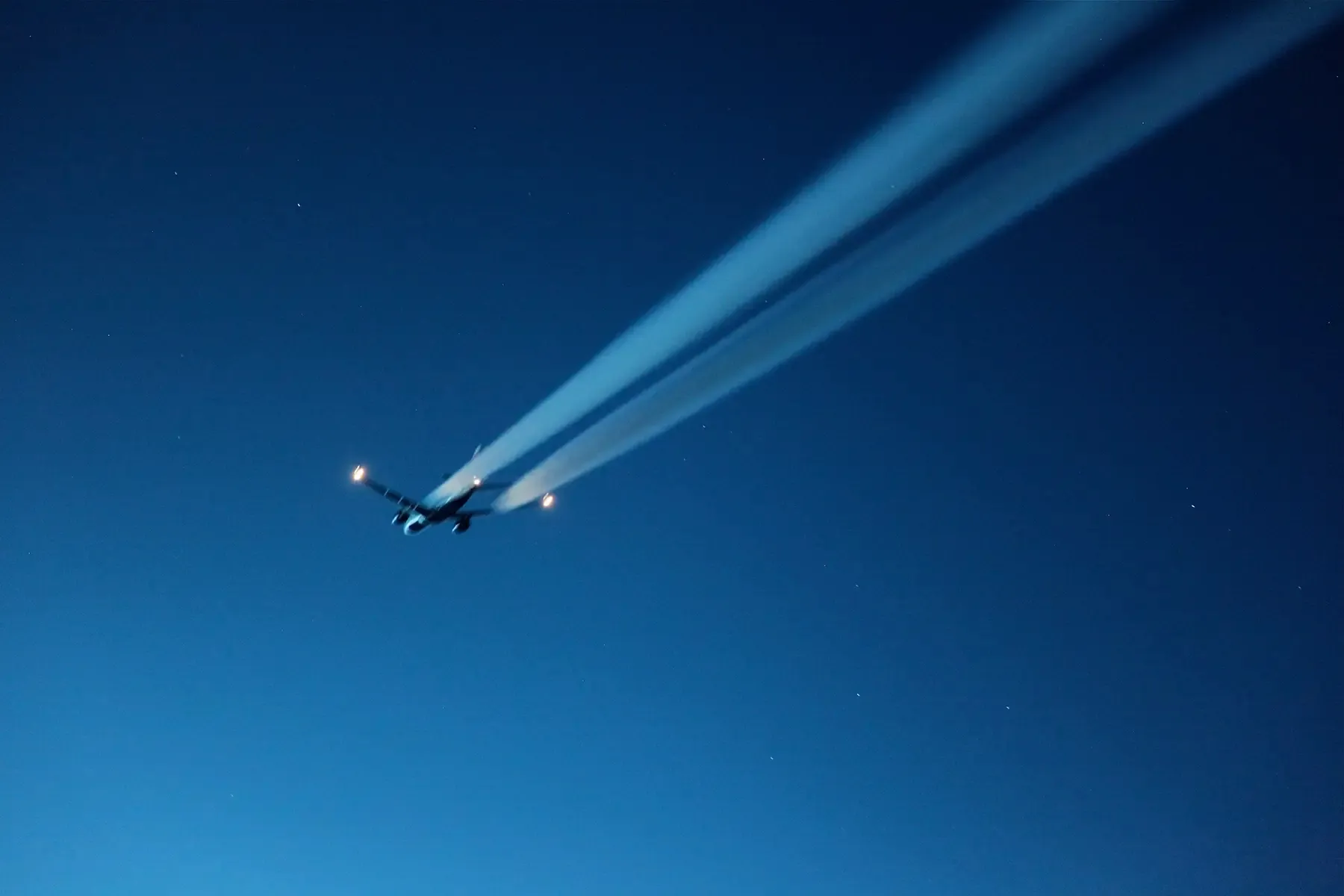
A commercial airliner cruises at approximately 550 to 585 miles per hour (mph), or 480 to 510 knots — close to Mach 0.85, meaning roughly 85% of the speed of sound. During takeoff and landing, speeds are much lower: around 160–180 mph (140–155 knots) on approach. The exact speed varies with aircraft type, load, weather, and altitude. Speed and altitude are closely linked: aircraft fly faster at higher altitudes where air is thinner, reducing drag.
Speed and altitude go hand in hand in commercial aviation. To understand why aircraft fly so high: What Is the Cruising Altitude of a Commercial Airplane?. For the relationship between flight mechanics and safety: How Does a Plane Fly?.
Takeoff Speed
A commercial jet lifts off the runway at what is called V2 — the takeoff safety speed — which is typically between 150 and 180 mph (130–155 knots) depending on the aircraft type, weight, and runway conditions. Before this point, there is a decision speed called V1: below V1, the takeoff can be aborted if needed; above V1, the crew is committed to continuing regardless.
Rotation speed (Vr) — the speed at which the pilot pulls back on the controls to raise the nose — is slightly below V2, typically 140–170 mph. The actual liftoff happens within seconds of rotation.
Climb Speed
After takeoff, the aircraft climbs at a reduced airspeed to maintain the best climb gradient — typically 250 knots (around 288 mph) below 10,000 feet due to airspace regulations, then accelerating toward 300–350 knots during the climb to altitude. The climb phase lasts approximately 20–30 minutes for a medium-haul flight.
Cruising Speed: The Key Figures
Indicated vs. True Airspeed
There are several ways to express aircraft speed, which can be confusing. Indicated airspeed (IAS) is what the cockpit instruments show — it reflects the pressure of the air against the aircraft, not the actual speed through the air. True airspeed (TAS) is the aircraft's actual speed through the air mass. At cruising altitude (35,000+ feet), where air is thin, TAS is substantially higher than IAS.
A pilot might read 280 knots on the instruments (IAS) while the aircraft is actually moving at 500 knots (TAS) — over 575 mph. Ground speed (what a GPS shows) adds or subtracts wind speed on top of TAS.
Mach number: the ratio that matters at altitude
At high altitude, pilots manage speed using Mach number — the ratio of the aircraft's speed to the local speed of sound. Most airliners cruise at approximately Mach 0.82 to 0.85, which is 82–85% of the speed of sound. At cruising altitude (~35,000 ft), the speed of sound is around 660 mph, so Mach 0.85 equals approximately 560 mph true airspeed.
Going faster is possible but becomes inefficient: as an aircraft approaches Mach 1, wave drag increases exponentially, requiring far more fuel for minimal speed gain. Commercial airliners are specifically designed for efficiency at Mach 0.82–0.85.
Speeds by Aircraft Type
Short and medium-haul aircraft
The Boeing 737 family and Airbus A320 family — the workhorses of short and medium-haul aviation — cruise at approximately Mach 0.82 to 0.84, corresponding to about 530–540 mph at typical cruising altitude.
Long-haul wide-body aircraft
The Boeing 777 cruises at Mach 0.84 (approximately 560 mph). The 787 Dreamliner cruises at Mach 0.85. The Airbus A350 also cruises at Mach 0.85. The A380, the world's largest commercial airliner, cruises at approximately Mach 0.85 as well.
Supersonic: a historical note
The Concorde, retired in 2003, cruised at Mach 2.04 — over twice the speed of sound, covering the transatlantic route in about 3.5 hours. New supersonic commercial projects are under development but have not yet entered regular service.
Why Does Speed Matter for Flight Anxiety?
Many anxious flyers are reassured by understanding the physics of what a plane is doing at each phase of a flight. The speed figures above help explain why takeoff and landing — the phases that feel most vulnerable — are actually highly controlled, with specific speed targets that pilots must hit precisely.
Understanding the relationship between speed, altitude, and lift is fundamental to understanding how a plane stays in the air: What Is the Glide Ratio of a Plane?.
Sources and Further Reading
The Smithsonian's Air and Space Museum has published accessible coverage of commercial jet speeds and their evolution: Smithsonian National Air and Space Museum: How fast do commercial jets fly?.
Popular Mechanics explains the relationship between speed, altitude, and fuel efficiency in a clear, non-technical format: Popular Mechanics: Why Do Planes Fly at 35,000 Feet?.
Boeing's commercial aircraft pages include technical specifications for each aircraft type, including cruise speed: Boeing: Commercial Airplanes — Technical Characteristics.
FAQ
How fast is a plane going when you feel a bumpiness at takeoff?
The moment just before liftoff, the aircraft is traveling at approximately 160–180 mph. The runway surface irregularities you feel below that speed translate into cabin vibration. Once airborne, the aircraft rides on air — no more bumps from the ground.
Does the plane slow down during turbulence?
Yes. When turbulence is detected, pilots typically reduce speed to the 'turbulence penetration speed' — a lower Mach number that keeps the aircraft within safe structural limits while minimizing the forces transmitted to the cabin. The reduction is usually 10–20 knots and is a routine precaution.
Why does it seem to take forever to reach cruising speed?
After takeoff, the aircraft accelerates gradually during climb, simultaneously managing altitude, speed, and noise abatement procedures (keeping noise lower near populated areas). Full cruising speed is only reached once the aircraft has leveled off at cruising altitude.
Curious About How Flying Works?
If understanding the mechanics helps ease your anxiety, take a deeper dive: How Does a Plane Fly? explains the physics of flight in plain language.
And if understanding isn't quite enough, our fear of flying programs give you both knowledge and practical tools to fly with confidence.