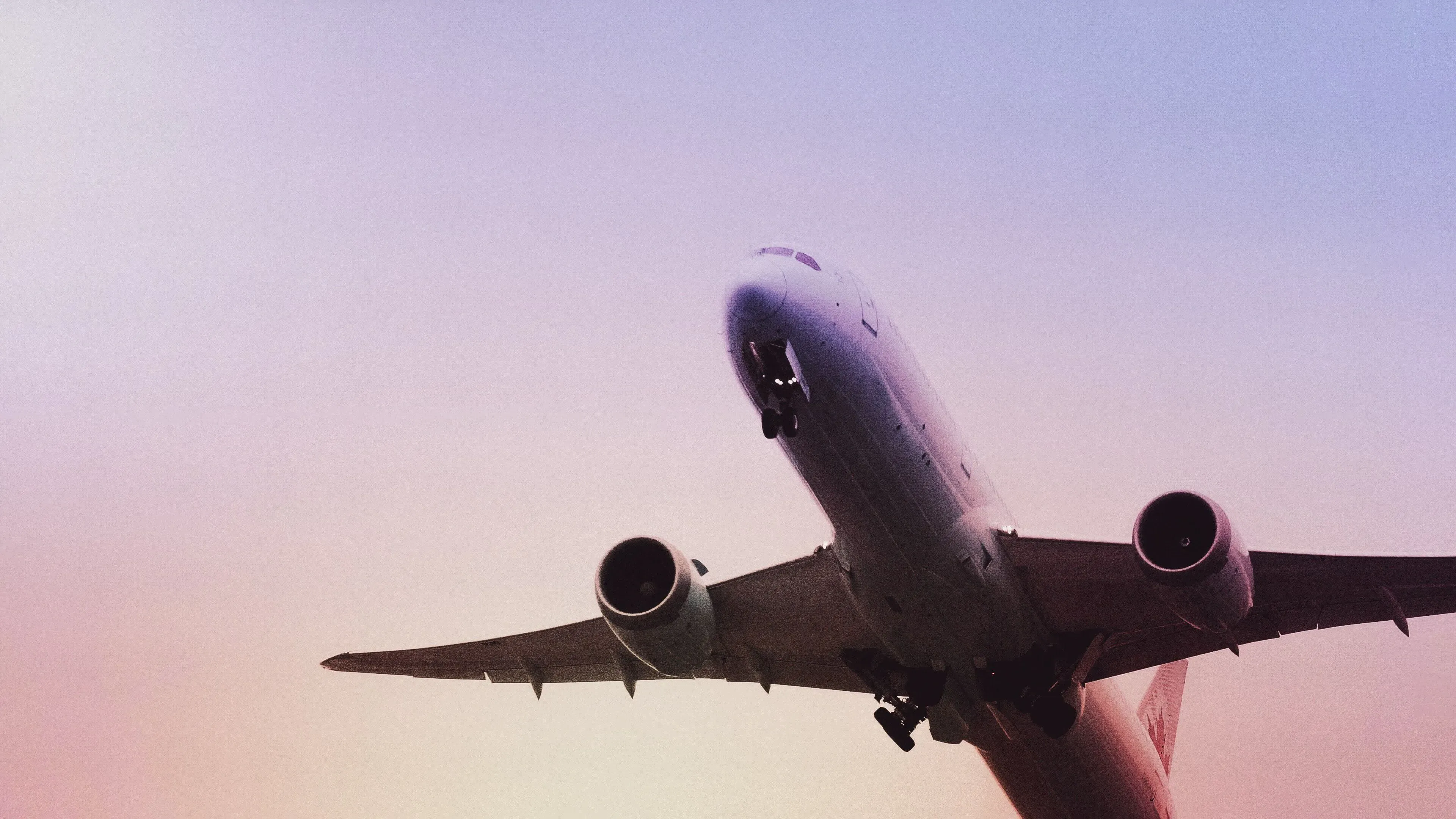
How Does a Plane Fly?
A plane flies because its wings generate lift — an upward aerodynamic force produced by the shape and angle of the wing as it moves through the air. Lift is generated through two complementary mechanisms: the pressure difference between the upper and lower wing surfaces (Bernoulli's principle), and the deflection of air downward by the wing (Newton's third law). As long as the aircraft maintains sufficient airspeed, lift equals or exceeds the aircraft's weight, and the plane stays in the air. It is physics, not magic — and the same physics that operate reliably on every commercial flight.
For the relationship between speed and flight: What Is the Speed of a Commercial Airplane?. For what happens when engines stop: What Is the Glide Ratio of a Plane?.
The Four Forces of Flight
Four fundamental forces act on an aircraft in flight: lift (upward), weight/gravity (downward), thrust (forward, from the engines), and drag (backward, opposing motion through the air). In level, constant-speed flight, these forces balance: lift equals weight, thrust equals drag. When they are out of balance, the aircraft climbs, descends, accelerates, or decelerates.
How Lift Is Generated
Wing shape: the airfoil
An aircraft wing has an asymmetric cross-section called an airfoil. The upper surface is curved; the lower surface is flatter. When air flows over the wing, it must travel different distances over the top and bottom surfaces. The air over the top travels a longer path and must therefore move faster to reach the trailing edge of the wing at the same time as air traveling over the shorter bottom surface.
Faster-moving air exerts less pressure (Bernoulli's principle). The result is lower pressure above the wing and higher pressure below — creating a net upward force. This is lift.
Newton's third law: deflecting air downward
The angle at which the wing is positioned relative to the airflow — called the angle of attack — causes the wing to deflect air downward. By Newton's third law ('for every action, there is an equal and opposite reaction'), pushing air down creates an upward reaction force on the wing. Both Bernoulli and Newton contribute to lift — neither explanation alone is complete.
How pilots control lift
During takeoff and landing, pilots extend flaps from the trailing edge of the wings. Flaps increase the wing's camber (curvature) and area, generating more lift at lower speeds — allowing the aircraft to lift off at a shorter runway distance and land at lower approach speeds. At cruising altitude, flaps are retracted and the wings operate in their cleanest, most efficient configuration.
How Engines Work
Commercial aircraft use turbofan engines. Air enters the front of the engine through a large fan, is compressed by a series of rotating compressor stages, mixed with fuel and ignited in the combustion chamber, and expelled at high velocity out the rear. By Newton's third law, expelling air backward creates forward thrust.
The large front fan (which gives turbofan engines their distinctive appearance) generates most of the thrust through the bypass flow — air that goes around the core, accelerated by the fan. This bypass air is cooler, quieter, and more fuel-efficient than pure jet exhaust.
What Keeps the Plane in the Air When Engines Fail?
This is one of the most common questions from anxious flyers — and the answer is reassuring. The wings continue to generate lift regardless of engine status, as long as the aircraft maintains flying speed. A commercial airliner can glide for a considerable distance even with complete engine failure. See: What Is the Glide Ratio of a Plane?.
Stability and Control
Why the plane stays level
Modern aircraft are designed with inherent aerodynamic stability — they tend to return to level flight without pilot input if disturbed. The horizontal stabilizer (the small wings at the tail) keeps the nose from pitching up or down. The vertical stabilizer keeps the aircraft from yawing left or right. The wing dihedral angle (wings angled slightly upward) creates natural roll stability.
How pilots steer
Pilots control the aircraft using three sets of control surfaces: ailerons (on the wings, for roll), elevators (on the horizontal stabilizer, for pitch), and the rudder (on the vertical stabilizer, for yaw). On fly-by-wire aircraft, the pilot's inputs are converted to electronic signals and processed by flight computers that implement the desired movement with precision.
Sources
NASA's Glenn Research Center provides authoritative, accessible explanations of aerodynamic lift: NASA: How Airplanes Fly — Bernoulli and Newton.
The Smithsonian's 'How Things Fly' exhibition is one of the best non-technical resources on flight principles: Smithsonian National Air and Space Museum: Principles of Flight.
BBC Science Focus explains lift and flight in plain language for a general audience: BBC Science Focus: How Do Planes Stay in the Air?.
FAQ
Is it Bernoulli or Newton that keeps a plane flying?
Both. Modern aerodynamics uses both frameworks, as they describe complementary aspects of the same phenomenon. Bernoulli explains the pressure differential from wing shape; Newton explains the reaction force from air deflection. Neither alone fully accounts for the lift produced by real aircraft wings.
Can a plane fly upside down?
Yes — briefly, and with modified airflow management. Aerobatic aircraft are designed with symmetric airfoils that generate lift equally in both orientations. Commercial airliners are not designed for this and would experience negative lift if inverted, meaning they would descend. Passenger flights do not fly upside down.
What happens to lift at high altitude?
As altitude increases, air density decreases, producing less lift at the same speed. To compensate, aircraft fly faster at higher altitude — maintaining lift by increasing speed as density decreases. This is why indicated airspeed (what the instruments show) decreases with altitude while true airspeed (actual speed through the air) increases.
Understanding Flight Reduces Anxiety
Knowing how a plane stays in the air removes one of the most common sources of in-flight anxiety: the belief that the plane is somehow 'held up' by something fragile or temporary. It isn't. Take the free quiz to see what else might be feeding your fear.
Our online program include deep-dive sessions on aircraft physics, led by pilots.
And for the takeoff and landing mechanics specifically: Why Do Planes Take Off and Land Into the Wind?.